4 Tips for Turning Your Customers and Donors into Passionate Fans

If you haven’t heard of Change the World By How You Shop, you’re in for a real treat! LeeAnne McCoy has been a member of the Signify community since the early days, and I can testify that she and her ethical shopping guide are dedicated to helping people find products that they’ll not only love, but allow them to make a difference.

And in the course of researching brands to include in her guide, LeeAnne has had dozens of conversations with makers and founders, and has unique insight into why some brands can turn their customers and donors into passionate fans while others simply sell their goods.

I’ve asked her to share those differences with you in the hopes that you can also make the leap from store to sensation. Because when you can successfully turn customers into advocates, you’ll be able to take your mission to a whole new level and make a bigger impact.

4 Tips for Turning Your Customers and Donors into Passionate Fans

A few months ago, one of Mercy House Global’s homes for teenage moms in Kenya burned to the ground. And in a passionate response to the tragedy, I watched the bars quickly fill up on their online fundraising campaign. Within a matter of hours, they raised thousands of dollars—enough to replace all the items lost in the fire including clothes, beds, and more for the young moms and their little ones.

And recently, Shelley, founder of Papillon, was visiting Haiti. She shared with her Facebook followers some of the medical needs of the artisans who work for her. Before she got on her flight home the next morning, she was able to tell her employees that people they had never met had donated enough to cover all their medical expenses. 

These kinds of stories are actually common for these two nonprofits. Not only do they quickly raise funds for their needs, but they also frequently sell out of newly released fair trade products. Why? 

They both have a very loyal following of customers and donors who are as passionate about their mission as they are. 

So, how can you turn your customers and donors into fans as loyal as those who follow Mercy House Global and Papillon? Below are four ways nonprofits and social enterprises turn followers into passionate fans.

1. Be Real

Lauren, owner of the small ethical online boutique Naupaka, is not afraid to admit her mistakes. As a one-woman-show, she sometimes sends out newsletters twice or sale notices on the wrong day and then sends a funny apology email with the correction.

Her transparency makes shopping from her online store feel like shopping at your local brick and mortar.

Shelley from Papillon is also very transparent about her challenges in running a nonprofit, as well as her relationships with her employees. She recently posted a live cell phone video on Facebook of the Papillon workshop in Haiti. Watching the banter, the smiles, and even those who ducked down because they were too shy to be on camera was like being there in person. This did far more to inspire support for Papillon than any professionally recorded video could have done.

Your supporters are inundated constantly with advertisements and requests for donations, but a sense of authenticity can make your requests stand out from the crowd. 


2. Be Personal

Because of the pandemic, connecting in person with your followers may not always be possible, but there are numerous ways to personally connect from a distance.

A handwritten note goes a long way. I treasure the many handwritten notes I have received from various social enterprises and artisans I support through Change the World by How You Shop. A personal email can have the same impact.

Facebook offers some great opportunities for connecting personally with your followers. Shop with a Mission has had to close the doors of their fair trade store in California all year because of COVID-19. However, they started weekly Facebook live shows where they laugh, tell jokes, host giveaways, and show off products. By watching the live shows, both local and out-of-state followers get to connect personally with the owners and employees.

Several other fair trade shops have utilized Facebook to introduce international artisans via live video. Others, like Mercy House Global, have created an “insiders” group which invites a small group of their fans to be a special part of their mission. Shelley from Papillon goes one step further and “friends” customers and donors on her personal Facebook page.

People are more likely to support organizations they have a personal connection to. Thus, the common joke about “Mom is my biggest fan.” Whatever method you employ, keep looking for ways to help your followers feel like they are personally invested in you and your mission. 


3. Be Specific

Recently, I purchased a basket from Eternal Threads, a nonprofit fair trade organization. Beautiful as the handwoven basket is, I bought it not just for its beauty or because I wanted to support a generic cause such as fighting poverty in Africa. I bought it because it was Rosemary’s basket. From following Eternal Threads, I had learned Rosemary’s story, how she lost both her parents and was raising her younger siblings and selling baskets to pay their school fees. I bought her basket to remind me to pray for Rosemary and because she inspires me. 

Even when you cannot share names or pictures, you can still be specific: 

Likewise, Papillon recently shared that one of their employees’ sons was HIV positive. Because of the stigma around HIV, they could not share names or pictures, but they shared enough details of the story to inspire many to donate.  

And when Mercy House Global started their fundraising campaign after the fire, they raised funds for specific needs, one at a time, such as mosquito nets, beds, and toddler clothes. Each individual need they posted was quickly provided for by donors who understood their mission, what was being asked of them, and what the result would be from their contribution.


4. Follow Up

Giving frequent updates on your supporters’ impact will strengthen their commitment to your mission. Papillon sends frequent updates to the donors who contributed to their employees’ medical needs. And Mercy House continues to send updates on the teen moms who lost their homes in the fire and the new homes they hope to purchase for them.

Eternal Threads, who sells Rosemary’s baskets, continues to share her story. Recently, her little brother was robbed and beaten on the way to work and his cell phone and bicycle were stolen. When they shared the need for donations to cover his medical care, it was simply one more chance to be part of an ongoing story.  The update and personal thank you from Rosemary they forwarded to donors ensured they would be quick to participate in the future as well.

Every little step you take towards having authentic, personal, specific, and ongoing communication with your followers will help build their relationship with you. And nurturing those relationships over time will turn customers and donors from occasional supporters into passionate fans who will be vital partners in accomplishing your mission.

It’s certainly worked for the organizations above. How will you make it work for you?


LeeAnne with Rosemary's products.jpg

LeeAnne McCoy is a mother of six young children and a piano teacher in Washington State. In her "spare time," she is also the creator of Change the World by the How You Shop, an online ethical shopping guide which makes it easy to find products from brands that go beyond ethical and fair trade to change lives around the world. Her mission is to support those brands by helping more people discover their products.

Facebook I Pinterest


PIN THIS POST FOR LATER:

In the course of researching brands to include in her ethical shopping guide, Change the World By How You Shop, LeeAnne McCoy has had dozens of conversations with makers and founders, and has unique insight into why some brands can turn their custom…

Kristi Porter, founder of Signify

I’m Kristi Porter, and I help cause-focused organizations understand and execute effective marketing campaigns so they can move from stressed to strategic. Your resources may be limited, but your potential isn’t. Whether you’re a nonprofit, social enterprise, or small business who wants to give back, I’ll show you how to have a bigger impact.

The Networking Matrix: How to Find People and Build Connections

Networking: No matter your organization or expertise, it’s one of the skills that everyone needs to grow their nonprofit or social enterprise. But, depending on your personality or interpretation of the word, you may be reluctant to pursue it.

Today’s post may change that, though. Using her proven “networking matrix,” my friend Sarah Voltmann Costello will demonstrate how to make your networking not only more effective, but remove any stigma you have about it being sleazy.

Authentic networking is simply relationship-building, and I know you’re already good at that. So, let’s just put a little intentionality behind it. Once you learn how to find the right people and build valuable connections, you’ll be able to increase your impact through new donors, customers, partners, and sponsors.

No one builds a successful organization in a silo, and this post will show you how to rally a community for your cause.

The Networking Matrix: How to Find People and Build Connections

Networking can be an intimidating thing to do. Awkwardness and fear of putting yourself out there as a professional is completely normal. You are in a different frame of communication than you’re used to.

You aren’t talking about things you saw on social media, music, or what you did this weekend. This is, in fact, an entirely different language from how you talk about your personal life. Knowing who you want to talk to, how to make an ask, and how to tell your “why” is an art.

The good news is, you’re not alone! And there are ways to create an action plan that takes the guesswork out of it.

As a military spouse, nonprofit professional, and social entrepreneur, this method of networking has become my lifeline for moving into new spaces (figuratively and literally). Perhaps you have experienced a career change, a sudden move, or you’re trying to establish a better network to leverage a better job. Whatever your reason for wanting to network, it can seem an impossible task until you break it down into steps. 

I had to learn this method the hard way, by starting over three separate times in three completely different regions of the U.S. I moved to Seattle in 2019 knowing only my realtor, but I now have a strategic network of over 250 individuals related to or able to empower my work here. And it took me less than a year to do most of that—you can do this, too!

So here we go! I’m going to share with you my method for adjusting quickly to a new scenario, how to connect with the people in your sector, how to make a plan for connection, and how to execute that action plan.

Let’s build your network matrix.

Six Degrees of Separation 

You have probably heard of the song, the film, and maybe even the Kevin Bacon game. “Six Degrees of Separation” is not a new concept; in fact, it dates back to 1929. That’s right, prior to computers, the internet, social media, and smartphones, experts claimed we were within six degrees of anyone we would want to meet. Nowadays, that number is even smaller!

Here’s how it works: Our network exponentially grows as we leverage the network of others. When we invite people into our network, we have the opportunity to leverage theirs. And even though we may not realize it, we are even within six degrees of someone like Richard Branson. All that’s required is some intentionality. 

How are you supposed to utilize this awesome web of connections if you don’t even know it exists? You need to create an action plan of who you’re trying to meet and how you plan to do it.

Without a plan, there might as well be 1,000 degrees between you and a “Richard Branson” figure. Going to a Rotary Club meeting, attending chamber of commerce meetings, or participating in any other networking group is great! However, allowing people into your network “as they come'' will not get you where you want to go quickly. It may happen eventually, but we have the opportunity to be more strategic.

Networking Graphic 1.png

The Six Basics of Networking

Start with the six basics: who, what, where, when, why, and how. 

WHO are you trying to connect with? Is it executives with decision-making power, HR representatives to get an interview, donors for your fundraising, investors for your product or service, or case workers in the field? Who are they and what role do they play? 

The next question to answer is, WHAT industries or type of work are you trying to connect with? For instance, nonprofits, government, public, or private are all areas to consider. Can you go further and break them down by industry codes or cause areas? The more specific you can get, the better you’ll be able to communicate your needs to others in your network.

These first two are key. 

WHEN and WHERE are very simple. You’ll need to answer for yourself, “What’s my time frame? WHEN am I trying to accomplish this?”

This long-term or short-term goal will dictate how many meetings you need to take per week. For instance, if you are moving to a new city and need to apply for jobs, you might schedule anywhere from three to seven networking meetings per week to get started.

Keep your WHERE simple. It’s the radius of where you need to network: city, state, or region. The tighter you can keep this radius, the more connections you will find immediately. 

Now, plan HOW you will connect with these individuals. Will you attend networking meetings, reach out to your existing connections, or rely on warm leads or introductions to meet new people? What groups are they associated with? What events are they speaking at? 

And finally, know your WHY—the story you tell or your elevator pitch—along with your “ask” as you start connecting with these individuals you’ve worked so hard to find. 

Let’s dig into each of these steps a little deeper.

6 questions

WHO AND WHAT

Let’s pause for a moment and discuss tools you already have at your disposal to define your WHO and your WHAT.

With the internet we are more connected than ever to all of mankind’s knowledge. Social media, government websites, Forbes, LinkedIn, GuideStar, and Google are powerful tools for helping you identify the organizations and individuals in the fields you need to connect with. And there’s no need to pay for expensive PROSPECT LISTS!

For instance, you might search for social enterprises in your area, or perhaps you’re looking for case management organizations. Maybe you need a list of millionaire CEOs who support equal hiring. Don’t reinvent the wheel: Check to see if someone has done this work for you already. And if you are struggling to find results, break your target audience into more manageable bites.

WHEN AND WHERE

Your strategy should be S.M.A.R.T: specific, measurable, achievable, realistic, and timely. When answering these questions, you should set Key Performance Indicators (KPIs) for yourself that let you know when you’ve achieved your goal.

Focus on what you’re trying to achieve. Is it quick employment, integration into a sector, or credibility in your line of work? Where are you trying to meet your goals? Which states or regions will you focus in? Can you narrow it down to specific counties in order to become well-known among common professional circles? When are you trying to achieve this? Is it in one year or immediately?

Set realistic goals for yourself such as:

  1. Attending one networking event per month

  2. Scheduling one to two networking meetings per week

  3. Focusing on one area where you will do the majority of your work to start (i.e. Seattle)


HOW

How will you connect? Are you starting from a foundation or are you starting from scratch? This is often the part that trips people up the most.

Start by building a spreadsheet of all the organizations you want to connect with, their employees, and the existing connections you have. 

On LinkedIn you have the ability to search any company, click on their employees list, and filter it based on 1st or 2nd degree connections. These are individuals in your network who are already connected to the people that you are searching for. You may be surprised by who pops up. Often it’s individuals that you may have spoken to before about introducing you to others, but without a targeted WHO and WHAT they didn’t know HOW to do that for you. Now you have the ability to give them a list of names and ask for targeted introductions. 

This changes the conversation entirely with the individuals you are trying to meet. Remember, when reviewing applicants, the recruiter’s job is to say “no” and narrow down the list. When networking, however, their job is to be social and “connect.” Build out your spreadsheet of existing connections and potential warm introductions and you will get to a “yes” quicker!

If you are starting from scratch, here are a few tips to get you started:

  1. Join groups on LinkedIn or social media that are relevant to your WHO/WHAT/WHY or background.

  2. Find in-person groups and networking events to attend regularly such as Rotary Club, BNI, Chamber of Commerce, etc.

  3. Collect business cards from everyone you talk to because you need a foundation to start with. DO NOT give them yours and expect them to email or call. You need to take the initiative.

  4. Send follow-up emails within 48 hours and ask for a quick phone call or one-on-one.

  5. Send thank you emails and LinkedIn connection requests within 24 hours of one-on-ones.

  6. Have a specific “ask” (or request) that includes referrals to their contacts.

  7. Update your networking matrix with your new contacts regularly.

WHY

When you finally reach the point of receiving warm introductions to the individuals you’ve looked for and researched, they’ll want to know WHY you want to connect. What will that story be?

Focus on being concise, telling a little bit about yourself, and detailing who you are trying to connect with.

For example, you can write emails like this one to your connections so they can forward it to the contacts you’ve asked to meet as an introduction:

Mr. Smith,

Thank you for taking the time to meet with me this week. I wanted to send a quick follow up with you about our conversation.

I mentioned that I was new to (city) and am building my network alongside my job search. I’m a X professional, with X years of experience in X and X. I’m passionate about X and want to meet other individuals who share that mentality. I’ve attached my CV for a bit more context on my background.

Can you introduce me to some professionals I should know who are involved in X industry/work? Thank you for your time!

Warm regards,

Your name


Your Network is Only as Good as Your Follow Up!

One final point: Networking works best when you focus on being of “service” to those you want to do business with. It’s not all about you.

What are they looking for?
What do they need?
Can you provide it or something similar?
Look for opportunities to be useful to them. 

This concept is called “servant leadership” and if you are looking to attract people to you and your cause, this is your strongest tool! When you put yourself out there to serve others, they will in turn look for ways to serve you, because they are grateful for you.

Build the mentality that you are searching for professional “relationships” not gum ball machines. Here are some tips:

  1. Take notes while you’re meeting.

  2. Follow up on something specific they said.

  3. If they helped you achieve something, thank them and return the favor.

  4. Respond within 24 hours.

  5. Ask for follow-up meetings and schedule immediately when you can.

  6. Find places to “bump” into them again.

Networking Graphic 2.png

Still Having Some Anxiety?

If you still feel like this process might not be for you, let me share some examples of success that I’ve had over the years using this approach:

  • Working for an international organization, my team leveraged this method to find STEM and business internships for students abroad to work in the U.S.

  • Moving from Indiana to Florida, I had to start over in a new line of work. I used this method to become a program director in the nonprofit sector.

  • The Air Force moved us from Florida to New Mexico, and I started a real estate social enterprise to employ myself. In six months, I had a team of 10 partners (real estate agents, investors, and fellow entrepreneurs) in three states to help me make offers on homes.

  • When we moved from New Mexico to Washington, we only knew our realtor. I used this method to meet nonprofit professionals with hiring power and gained a meeting with the CEO of a $140 million organization.

  • Through my networking matrix, I was referred and asked to serve as a volunteer consultant for immigrant/refugee serving organizations. I gained employment with one of the nonprofits shortly after.

  • Now I use this method to meet major donors and to establish a social enterprise for a nonprofit in the Southeast.

The most important theme in all these successes is not determination or ingenuity, but service to others. Keep that mentality as you’re networking and you will find doors opening for you.

GOOD LUCK OUT THERE!


Sarah Voltmann Costello.jpg

A nonprofit professional, Air Force wife, and social entrepreneur, Sarah Voltmann Costello has spent the last 11 years building a career centered on the ideals of a global mindset and nonprofit efficiency practices while being a trailing spouse.

Leveraging her Network Matrix strategy, she has learned to be a highly adaptive and tenacious “servant leader,” focused on driving greater impact in our global community by supporting nonprofit leaders in their missions wherever she is placed. Over the years of working with more than 60 nonprofits across multiple impact areas, she has learned to leverage the existing assets of an organization to build strategies for real growth that can be multiplied toward large-scale community development.

Today, Sarah lives in the beautiful PNW in Seattle, WA, with her husband, and leverages these strategies to break down barriers for nonprofit leaders around the U.S. by building sustainable fundraising or social enterprise ventures.

LinkedIn


PIN THIS POST FOR LATER:

Networking: No matter your organization or expertise, it’s one of the skills that everyone needs to grow their nonprofit or social enterprise. And authentic networking is simply relationship-building. Once you learn how to find the right people and …

I’m Kristi Porter, and I help cause-focused organizations understand and execute effective marketing campaigns so they can move from stressed to strategic. Your resources may be limited, but your potential isn’t. Whether you’re a nonprofit, social enterprise, or small business who wants to give back, I’ll show you how to have a bigger impact.

4 Ways to Help Donors and Customers Find Your Social Impact Mission on Google

Getting found by your ideal customers and donors on Google . . . it’s the Holy Grail, isn’t it? It’s one of the main reasons you created your website, but you quickly learned that it isn’t a “build it and they will come” scenario.

Or, is it?

While it’s not easy and it does take time, there is one method that you can’t overlook if you want your nonprofit or social enterprise to show up on that coveted first page of Google: Search Engine Optimization (SEO).

By this point in Internet history, you’ve probably heard the term, but you may be lost as to what it is and how to make it work for your mission. I know I was. For several years, I tried to learn from the latest guru but kept getting overwhelmed and scratching my head—until I met Meg Casebolt of Love At First Search.

Meg is the first person to make SEO click for me, and she’s going to break down some of the basics for you below. If you start to put her advice into action, you will see results. After taking her course, I have seen a steady uptick in new leads and clients from Google! And it’s exciting every single time.

Your work deserves more attention and with Meg’s advice, you can help ideal customers and donors find your social impact mission on Google.

4 Ways to Help Donors and Customers Find Your Social Impact Mission on Google

Let me guess, when you first announced your nonprofit or social enterprise and launched your website, you expected people to come to you in flocks. And maybe they did . . . at first! Who wouldn’t? You’re awesome and you believe in what you do, and it’s having an impact on the world! 

But now that the initial excitement has worn off, your social media channels aren’t getting as many clicks as you’d like and it seems that all your efforts are falling flat. You know that you have the power to change lives, but people just aren’t finding you.

What if I told you there’s a way to help more people find your amazing cause online?

When people want something, they search for it, and if you set your website up correctly, it can show up around the clock to lead them to learn more about your cause. The secret to getting those new leads from Google? It’s called search engine optimization, or SEO.

I know it might sound intimidating or even a little sketchy (we all get those spammy emails!), but I promise that the SEO tactics below are all based in solid business practices. Good SEO, applied to your blog posts in particular, will help every part of your online presence so that more people are aware of the beneficial work you’re doing.

Wait, What is SEO?

To put it simply, SEO is a collection of activities to improve the amount and quality of organic traffic reaching your website from search engines. It’s the way that people find answers to their questions on traditional search engines (like Google, Bing, and Yahoo) and also on sites you may not think of as search engines (like YouTube, Pinterest, eBay, and Amazon) and even industry specific directories like Charity Navigator or Guidestar by Candid.

Optimizing for search means that you’re trying to get search engines like Google—the world’s most popular search engine—to see your website and blog posts or other content as both knowledgeable and trustworthy, and to lead people to it quickly and efficiently.

And the combination of more people finding you plus being seen as knowledgeable and trustworthy means an increase in sales or donations.

There are three main components of SEO:

  1. Content (pages, blogs, videos, podcast show notes, infographics, etc.)

    Search engines are constantly reviewing new and fresh content on the internet. When someone types in an online query, Google searches through a huge index of text and tries to find content that has the information they’re looking for. 

    When it comes to content, a major part of the SEO process is keyword research (aka figuring out what people are searching for) by finding the intersection of:

    • What you want to be found for

    • What people are searching for

    • What doesn’t already have a gazillion results

  2. Ease of Use

    When search engines deliver results, they want people to get the answers they’re looking for quickly and easily. So, if your site takes forever to load, is hard to read on a phone, or has tons of dead-end links, Google doesn’t want to share those results with people. Search engines want to recommend sites that not only answer people’s questions but also look good doing it—just like you, hot stuff!

  3. Reputation

    Google relies on other sites to tell it how credible and trustworthy your site is. So, how do other sites give you the digital equivalent of upvotes? By linking to your site. And for once, the SEO gods have given us an easy-to-understand term for this: backlinks

    Backlinks are any links from other sites to yours. The best backlinks come from websites in your industry that have high authority (aka they have a lot of backlinks going into their site).

You can write the best blog post in the world and have the smoothest user experience, but if nobody trusts you? Womp womp, sad trombones.

What are some easy ways to get great backlinks for your nonprofit? Sign up for popular directories like Guidestar by Candid and Charity Navigator, post your job listings on Idealist, write guest blog posts for the Chronicle of Philanthropy or Nonprofit Quarterly . . . and make sure they all link to your website.

For you guys in the social enterprise space, you can become a member of the Social Enterprise Alliance, register as a B Corp, participate in 1% for the Planet, or any other number of organizations that have trusted online directories.

Even more PR-related opportunities like being a guest on a podcast (that has online show notes) or being listed as a speaker on a conference website helps to build those coveted backlinks.

Local SEO for Nonprofits and Social Enterprise Businesses

If you serve a specific geographic area with your services, you also want to consider Local SEO tactics. 

The first step for Local SEO is to set up a free Google My Business account, where you can easily tell Google where you’re located (if you have a brick and mortar location) and/or where your service area is (if you’re a home-based business or meet your clients at another location), as well as what you offer and who you serve.

Google My Business is a great tool not only for you to directly share your business information with Google, but also to solicit feedback from your clients, who can add reviews and user-generated content like photos directly to your account. This would then allow searchers to see them in Google Maps and/or local listings . . . like the B Corp company that installed our solar panels, which shows up in search results for terms like “green energy rochester ny.”

But how do you FIND those phrases that people might be looking for? 

Keyword Research for Cause-Focused Organizations

You probably already have some ideas for topics you could show up for like “educational charity atlanta” or “community gardening initiative” or “microfinance for poverty alleviation.” And you might have those words plastered all over your website. 

But is that really what your people are looking for? How do you know what they’re typing into Google?

Simple: keyword research. 

Keywords are the phrases in your web content that make it possible for people to find your site via search engines.

And often, the words that WE use (as people who deeply understand and care about our missions) are different from the words that new people search. 

For example, TOMS shoes starts their website with “we’re in the business to improve lives,” but do you know what keywords their traffic actually comes from? Keywords like “booties” (they get ~5000 visitors/mo from that), “wedges” (3500 visitors/mo). And “slip on shoes” (~2500 visitors/mo).

And it’s not just those large categories that TOMS shows up for . . . they also get about 75 people per month for “black canvas shoes” and 65 for “captain america shoes.” 

Those people aren’t specifically looking for TOMS because of their mission or corporate giving program, they just need new shoes, and it’s not until people get to the website that they find out about the company’s social impact. That’s not necessarily what they’re searching for, but it might be why they trust the company and want to buy once they discover it.

Here are three steps to help you get started with keyword research:

  1. See what people are asking about your topic

    The best way to answer people’s questions is to go to the places they’re asking them and look for trends. So poke around the web! How do you know what phrases people are actually searching for once they get to Google? Easy! Use a keyword research tool.
    Type your topic into an idea generator tool like Answer the Public or Also Asked to get some fun ideas of the types of things people are looking for. 

  2. Find the right keyword phrases

    One of the best free keyword research tools is Ubersuggest. It gives a ton of keyword research data to you—for free—in a user-friendly way. Using a tool like this, you can do some research on the keywords and topics you want to get out to the world and get an idea of how many people are searching for it. You can also get an idea of the SEO difficulty of these keywords, or how competitive that search term is. The lower the number, the easier it is to rank for that search term.

  3. Choose 1 primary keyword and 2-3 secondary keywords

    In order to be super clear with Google about your topic or expertise, you should choose ONE KEYWORD that is most important to your end goal so that your writing has something to focus on. Then, you can sprinkle a few other keywords throughout your writing to make sure Google knows that they’re related. 

    If you’re having trouble narrowing down a keyword, don’t worry about it! Select a group of keywords for a specific post, and then if you find other keywords you like, write another post to talk about those!

You can create as much content as you’d like, and you can rank for infinitely keywords. The Red Cross has over 300,000 keywords pointing to over 10,000 pages on their site—heck, they have 14,000 keywords just about CPR!—so don’t feel like you have to limit yourself to a top three for your entire site. 

Keyword selection criteria

How do you select a good keyword, you might ask? For my visual learners, these are the three qualities of a good keyword. We’re aiming for that sweet spot in the middle). 

Screen Shot 2021-04-18 at 11.46.44 PM.png

And here are some examples of how detailed your search terms can be, so you can start thinking about the level of detail that you need to rank for a high volume, low competition keyword:

Picture2.jpg

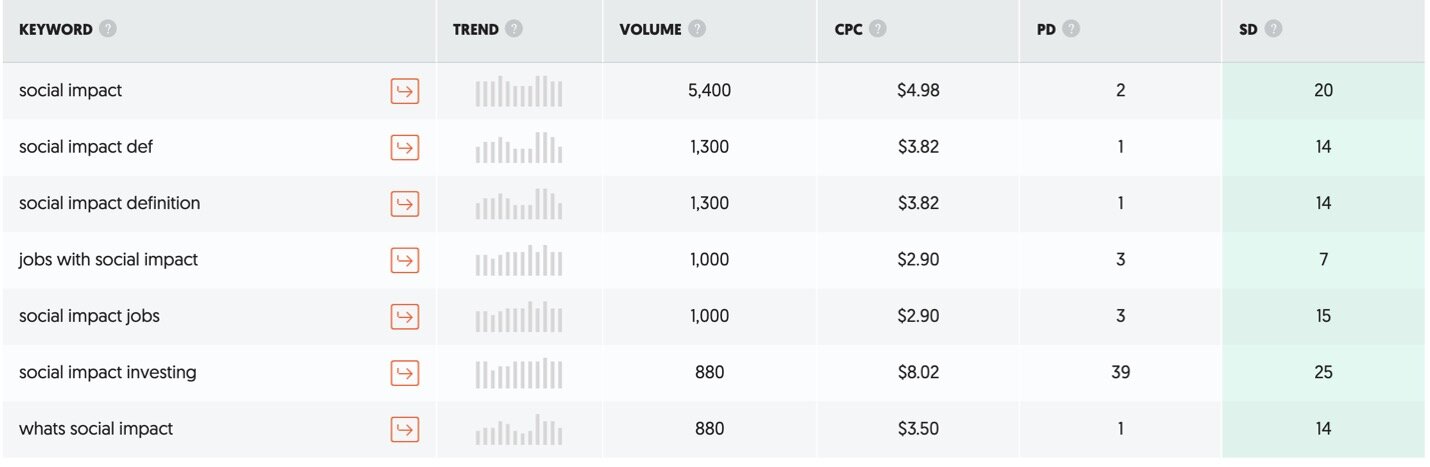
Let’s take a look at what comes up when we search for “social impact” in Ubersuggest.

Picture1.jpg

Here, we see that people are indeed searching for “social impact,” and we can see all the important metrics. VOLUME is the average monthly number of people searching that phrase, CPC and PD are about how many people are running Google Ads and how much they’re paying, and SD is “search difficulty” (how easy it would be to rank for that term).  

So when you’re looking at these numbers: The higher the volume number the better, and the lower the “SD” (aka SEO difficulty, aka competition) number, the better.

And if we search “social responsibility,” as seen below, we have even better volume numbers, meaning more people are looking for content relating to social responsibility! So, you may want to focus on a blog more catered to this topic.

Alright, so you’ve done your research and you have a keyword now, but I bet you’re wondering where it should go on your site or in your blog . . .

Picture1.jpg

Where Do I PUT the Keyword in My Content? 

There are seven key places where you can include your keyword in the text of your website and your content. You should aim to include it in all these places, but if it doesn’t quite fit into one, it’s okay. It’s more important to be easy to read than to have the perfect placement.

  1. Your SEO title (the blue text in search results)

  2. Your URL slug (the part after the domain)

  3. Meta description (the black text in search results)

  4. Headline (the title of your post and your H1 headline)

  5. In a subheading (H2-H6: you can have as many of these as you want)

  6. In your image description(s) as an “alt” tag

  7. Sprinkled throughout the body copy

The most important place to include your keyword is your SEO title, which is the blue text that shows up on the search engine results page. You want to include a keyword, but also write a title that people actually want to click on! 

I like to use CoSchedule’s Headline Studio to double check my post headlines (and email subject lines) to make sure they’re the right length, follow a great format (lists and questions do well for SEO titles), and include powerful word choices that make people more likely to click. 

 If you can’t immediately convince people who see your site on Google to click on it, it doesn’t matter how good your content is! You have to make an immediate impression. And your SEO Title will do just that.

Questions to Ask Before You Write a Single Word

Now, before you go writing a few pages and invest hours into your next blog post (or whatever content you plan to create) to promote your stellar social enterprise or nonprofit, ask yourself these four questions to get clear about how that content can get found on Google and turn your readers into customers or donors:  

  1. Why does my audience need to know this?

    If you can’t identify why you’re writing the post: don’t write it. BUT. If you can pinpoint the problem that you’re solving or advice you’re giving your reader by writing a post? By all means, continue.

  2. How is this different from existing content on this topic?

    You’re probably not the first person to write about whatever is on your mind. But you do have a unique point of view to share with your audience. Take a look around at what’s being written by other people in your industry. Think of a new approach to what’s already been said. Showcase what makes you different.

  3. How can it help me when someone finds this?

    Remember, everything on your website should help lead the reader to becoming a customer or donor. What’s the end product, service, or mission that your audience needs or should know about? 

  4. What do I want the reader to do after reading?

    What’s the goal of this post? What will be the Call to Action (CTA) for the reader to thank you for generously sharing your awesomeness? Should they make a donation, buy a product, subscribe to your newsletter, or attend your event? Make sure everything you write is leading to that CTA.

Going the Extra Mile: A Quick SEO Blog Checklist

Now that you know what people are searching for and you’ve got those keywords selected and prioritized, it’s time to get writing! To make sure you really have all your ducks in a row and to ensure your blog is in the best position to get noticed, follow the below steps before publishing anything. 

  • Choose your topic

  • Research keywords (remember: specific, relevant, uncommon)

  • Draft your title (Include your keyword and keep it intriguing!) 

  • Write the thing!

    • Break up your ideas with subheadings

    • Work in your keyword and related words naturally (ideally every ~250 words)

  • Add images (you should have at least one as the featured image)

    • Name the file with your keyword

    • Add an alt tag on each

  • Add internal links to other resources on your site

  • Add external links to relevant places around the internet

  • Prep the listing

    • Make sure the title is 30-65 characters

    • Update the URL/Slug (include keyword here!)

    • Write the meta description (155 characters)

  • If you have Wordpress, double check your Yoast traffic lights.

Get the full comprehensive SEO checklist here.

Need some hands-on support with SEO for your social enterprise or nonprofit? 

If you don’t want to DIY your SEO, come check out my Attract & Activate membership, where we help small businesses and cause-focused organizations to reach and convert their ideal customers and donors through the power of SEO.

(KP note: I can attest first-hand as to what a patient and fun teacher is! There is a strong learning curve for a lot of us when it comes to SEO, but Meg will do everything in her power to make sure you can understand and implement her ideas. Plus, after those leads start coming in, you’ll be glad you took the time to learn a new skill!)


Meg Casebolt is the owner and founder of Love At First Search and has been helping online business owners create beautiful, search-friendly websites and strategic content for the past eight years. 

Before launching Love At First Search, Meg spent nine years in the nonprofit sector, working in the development teams at Big Brothers Big Sisters and Partners In Health, while earning her Masters in Community Economic Development.

She’s your no-B.S. bestie who makes it super easy for your dream customers to find—and adore!—your organization online, resulting in effortless web traffic, consistent customers, soaring profit and donations, and SO much more time (and sanity)!

Website I Facebook I Instagram I LinkedIn I Pinterest I Youtube


PIN THIS POST FOR LATER:

4 Ways to Help Donors and Customers Find Your Social Impact Mission on Google

Kristi+Porter,+founder+of+Signify.png

I’m Kristi Porter, and I help cause-focused organizations understand and execute effective marketing campaigns so they can move from stressed to strategic. Your resources may be limited, but your potential isn’t. Whether you’re a nonprofit, social enterprise, or small business who wants to give back, I’ll show you how to have a bigger impact.

How to Navigate the Legal World of Cause Marketing

When I first heard Sam Mazzeo of In Better We Trust speak at a conference a few years ago, I was immediately impressed with his ability to make legalese sound interesting and approachable. I know, what a skill, right?

So, when he posted about cause marketing on social media a while back, I knew I needed to have him further explain it to you as both a lawyer and an advocate of social impact. If you’ve been looking for the one-two punch of a for-profit / nonprofit partnership, you’re gonna want to listen up, and maybe take some notes.

Commercial Co-Ventures may not be a term you’re familiar with (yet), but you’ve certainly seen it in action—and you’re probably dying to give it a try. However, before you jump into this type of committed partnership, read Sam’s take on how to navigate the legal world of cause marketing. Your cause will thank you.

chris-liverani-9cd8qOgeNIY-unsplash (1).jpg

WHAT IS CAUSE MARKETING?

You may not know it, but Cause Marketing, or Commercial Co-Ventures, is all the rage in the social impact space these days. So, what is it?

Cause Marketing is when a for-profit business promises to donate a portion of their sales proceeds from a product or service they sell to a nonprofit organization.

Simple, right? Not so fast . . .

Typically, the for-profit already sells products or services and, by virtue of making a promise to donate a portion of its revenue to a charity, the marketing campaign becomes a Cause Marketing campaign. Meaning, this can happen legally even if you didn’t intend it to!

A successful example of Cause Marketing (that didn’t happen by accident) is the NFL’s A Crucial Catch Campaign, also referred to as “NFL Pink.”  This campaign is a joint effort between the NFL and the American Cancer Society to raise money for cancer research and awareness. The NFL auctions game apparel and equipment that bears a pink ribbon logo and sells NFL Pink merchandise. In turn, the NFL donates a portion of proceeds from these auctions to the American Cancer Society. Not only does the NFL gain some positive PR, but the American Cancer Society has also received approximately $7 million dollars from the campaign.

Not too shabby, right?

THE FINE PRINT: REGULATIONS ON A COMMERCIAL CO-VENTURE

Obviously, when a Cause Marketing campaign is successful, both the non-profit and the for-profit benefit financially and in a public relations sense. Cause Marketing, however, does require some compliance and oversight to keep it legal.

In many states, when a business engages in Cause Marketing, the business and non-profit legally become a commercial co-venture, which can trigger various regulations. Marketing language that puts you in the commercial co-venture category includes:

  • For each ______ sold, we will donate to ______.

  • Send in five ______, and we will donate $10 to ______.

AKA if you advertise to the public that proceeds will be donated from sales, you’re in the Commercial Co-Venture world, folks!

Many states have implemented regulations on commercial co-ventures in an effort to keep consumers well informed and to ensure businesses do not merely say that proceeds go to charity when they actually do not. Regulations and enforcement vary from state to state, which can present some difficulties and confusion for national campaigns.

Cause Marketing Regulations and Requirements

Generally, the regulations and requirements include:

  • Registration Requirements: A requirement for the business to register with the state by filling out a commercial co-venture registration form. Generally, annual reports must be filed with the Attorney General of each state.

  • Contract: In some states, the business and the charity must enter into a written contract with specifically required provisions and file the contract with the state.

    • Pro California Tip: In California, if you have an agreement in place with the nonprofit, you likely don’t have to register with the Attorney General!

  • Reporting by Charities: In some states, the charity must file a statement prior to the campaign and include the promotion in its annual reporting.

  • Accounting: A complete accounting and retention of those records is often required upon completion of the campaign.

  • Disclosures: The for-profit is likely required to include language regarding the specific amount or percentage of proceeds that will be donated in all of the campaign materials.

Unfortunately for all of you cause-marketers, states vary as to the extent of enforcing these regulations. Generally, the biggest consequence in failing to comply is bad publicity for the for-profit.

For a Goliath like the NFL, bad publicity is pretty easily absorbed. For a growing business or new nonprofit, on the other hand, bad publicity can be disastrous. For example, take the case of a for-profit that was required to contribute additional money to a nonprofit because the language in a campaign was ambiguous or misleading in regards to how much of the consumer’s purchase would be donated. In 1999, Yoplait was required to pay several million dollars in additional contributions to the Breast Cancer Association because of unclear promotion terms.

To sum it all up, find a sweet product that your nonprofit wants to endorse (or find a sweet nonprofit if you’re the for-profit), create a joint campaign that is compliant and discloses the donation percentage, and shout that campaign from the rooftops.

If all goes well, the nonprofit sees an increase in donations and the for-profit sees an increase in sales. It’s a win for everyone!

Still confused? Watch me explain it again in this video.


Sam Mazzeo is a Renaissance man, but like, an approachable one.

Here are some things he can help you better understand: trademark, business formation and securities, contracts, Halloween party planning, how to do a standing backflip, and the proper pronunciation of the word “GIF.”

But he can’t help you if your questions are related to birds. He isn't a big fan of birds.

Website I Facebook I Instagram I LinkedIn


PIN THIS POST FOR LATER:

Wondering what makes a #nonprofit / for-profit partnership legal? Here is a quick explanation of cause marketing and the legal requirements.

Kristi Porter, founder of Signify

I’m Kristi Porter, and I help cause-focused organizations understand and execute effective marketing campaigns so they can move from stressed to strategic. Your resources may be limited, but your potential isn’t. Whether you’re a nonprofit, social enterprise, or small business who wants to give back, I’ll show you how to have a bigger impact.