Nonprofit

Why Free Help Isn't Always the Best Option

Whether you are just getting your organization off the ground, are in a growth phase, or are trucking along at a good pace, today's topic has probably hit your radar at some point. So far this month, I've covered the lessons I learned from my first year in business, 10 tools to make your small business look more professional, and my favorite tip to get people to spread the word about you. But now, I want to address how you should approach a situation in which you're asked for, or offered, free help.

No matter from what perspective you're reading this post, as a "do good" organization, you likely have a love-hate relationship with free help. You're either at a nonprofit or purpose-driven, for-profit who has taken advantage of long- or short-term volunteers, or you've been asked to do something for free for which you'd normally charge. 

And you likely have both good and bad experiences. I know I do.

Here's why free help isn't always the best option for nonprofits and social enterprises.

Volunteers and interns can either be the best thing that ever happened to you, or the worst. Nonprofits often heavily rely on volunteers to keep the doors open. And social enterprises, especially just starting out, may be in the same position. Sometimes these people are even called interns, and become more of the process. You, like me, may also know fully-functioning businesses that are solely run by volunteers. Any of these can be a great strategy. But, it just depends on who these people are, and how hard they're willing to work. Regardless, a system should be put into place to account for any "bad eggs" that do come along. In these situations, people rarely have bad intentions. They may, however, have a bad work ethic. Or the scope of the position may change, or it was never adequately explained. There can easily be fault on both sides.

On the flip side, there may be times when you or your organization is asked to do something for free. It could be offering your service at an event, like providing free coffee at a conference. Or it might be giving away your product, such as samples in a goodie bag. As before, neither is a bad option. In fact, they could lead to other revenue sources or exposure you might not receive otherwise. But every opportunity should be carefully thought out. I don't think there is a blanket response. Value is measured in more ways than one.

In today's post, I shared with the folks over at Horkey Handbook all about the pros and cons of either being approached by someone who offers their help for free, or how to handle being asked to do something for free. 

READ THE FULL POST HERE.


PIN THIS POST FOR LATER:

There are both values and costs when it comes to volunteers and interns. Social enterprises and nonprofits must weigh the pros and cons when either offered free help, or asked to provide their service or product for free.

Kristi Porter, founder at www.signify.solutions

I'm Kristi Porter, and I started Signify to provide writing, consulting and strategy services to nonprofits and for-profit organizations with a social mission, primarily through copywriting, marketing and business communications. I believe that cause-focused organizations like yours are the future of business. You're proof that companies can both make money and do good. And I'm here to help you get noticed and grow. When you succeed, we all win.


Make It Easy For People to Talk About You

This month we've been talking about building your business, lessons to learn from, and making it look more professional. Today I want to give you one of my top tips for getting the word out about your organization, a new product or service, latest initiative, or some other big news you want people to know about.

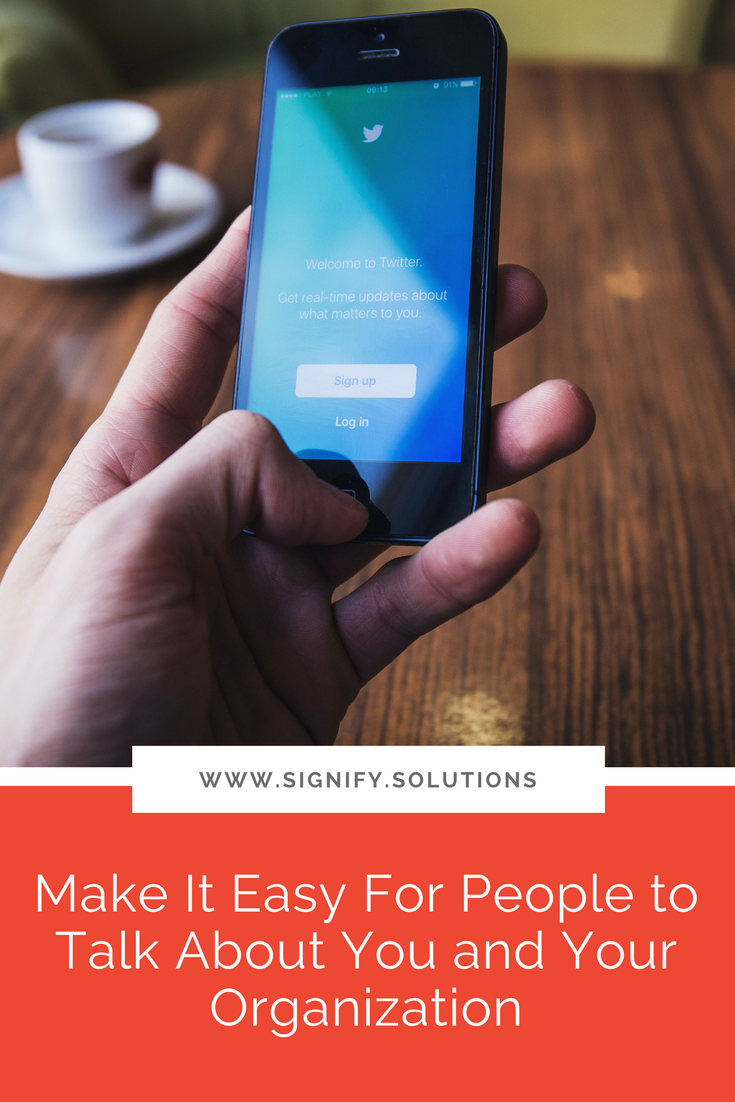
Make it easy for people to talk about your organization, your latest initiative, a product or service, or your latest big news with this one, simple, but powerful tip.

I first heard about this strategy in an interview Jon Acuff did years ago with Connect Faith magazine. It certainly wasn't the focus of the article. It was just sort of a side note in the feature, but it stopped me in my tracks. I think I literally quit reading and exhaled, "hmmm," aloud. It was so simple, but so remarkable for me as an event marketing professional. I started implementing it immediately, and never looked back. It was an incredibly effective tool for the organization I worked for at the time (that they still use), and it's proven itself time and again for the clients I work with now.

So, what is it?

Provide social media samples and images for your network of influencers.

Make a Big Impact on a Small Budget

Let me explain. You likely write emails, blogs, and social media posts for your organization's latest, greatest, and next big thing. You spend a lot of time crafting exactly what needs to be said, sending it out to your database, and posting it on your social outlets. If you have a staff or board, maybe you even give them a nudge to forward and share it. You're excited, and you know they will be too. You're gearing everyone up to shout this message from the rooftops! Perhaps, if you're a real go-getter, you even send a reminder.

But after the launch, you look back and hear . . . crickets.

Few people shared the message.

They said they would. They were excited. They had every intention. But, in the end, time or writer's block or a Netflix binge got in the way.

They'll do better next time, right?

Maybe. I'm not usually a cynic, so it's entirely possible. But I'd rather you provide all influencers with sample social media posts and images to make it as easy as possible for them to talk about what you've got going on.

In the interview I mentioned above, Jon stated that when the events he was speaking at provided him with posts he could literally copy and paste on his social media outlets, it removed any barriers to his good intentions slipping away. 

Sure, you'd probably rather someone gush in their own words about your organization, but what's better: the slim chance that they might do it, or the high probability that they will? I think most of us would prefer the second option.

So, that's what I started doing and it worked BIG TIME! Awareness and engagement increased. Influencers thanked us for supplying them with exactly what they needed, and in the end, we reached more people, sold more products and event tickets, and gained a larger base of supporters.

What's an influencer?

This might all sound great to you, but perhaps you're asking yourself exactly who an "influencer" is and how you find one of these mythical creatures. Probably the purest definition from a marketing perspective would be someone with a large and established network. They influence crowds. These are usually big name folks. 

Maybe this is the person who started your organization, a spokesperson, a celebrity affiliation, well-known speaker, author, or personality, and people like that. To work with them on the level I'm talking about here, you'd already need an established relationship. It's highly unlikely that you can just email George Clooney and tell him that your organization provides relief to third world countries, and by the way, you have a new product coming out, and would he post it on Twitter if you wrote him the samples . . . Ummmm, sadly, probably not. (But if you try it, and it works, please let me know!)

In addition to the types of men and women with large networks, I believe you should also include all others already in your circle. The "low hanging fruit," if you will. After all, everyone has a network of some size. And sometimes grassroots movements are the most effective. So, be sure to include staff, volunteers or interns, board members, event speakers, and anyone who has a vested interest in seeing your organization or event succeed. When you've made it this easy for them, you might just be surprised who ends up sharing.

21 Free or Cheap Marketing Ideas

What should you include?

As mentioned, you should include pre-written social media samples and images. The three I am typically asked to write for include Facebook, Twitter, and Instagram. But you'll need to determine if those are right for you.

Here are a few other tips:

  • Make sure all pre-written text is the correct length for each outlet. For example, don't send people copy that should be Tweeted about, but extends well beyond the 140 character count. #annoying

  • Ditto with images. They aren't a one-sized-fits-all. Make sure you provide images that are correctly sized for wherever you're asking them to share.

  • Write it from that person's point-of-view, when necessary. At times, it may be fine for everyone to say the same thing in the same way, but with some easy tweaks on your part, it will be far more effective. For example, if you're sending these items to event speakers, write it as "I'm speaking at..." rather than just general event info. (Or include both)

  • Try writing two to five examples for people so they can use whatever fits their voice/brand, or can say different things at different times without just sounding repetitive.

  • Encourage people to customize the text for their own voice or brand, but don't expect it. Some will, but most won't.

  • Always provide a deadline or schedule, and always send a reminder. Again, people are busy, so if you're on a timeline, they need to be made aware of it.

  • Deliver it in whatever way works best for you and your crowd. This may be via email, Dropbox, Google Drive, Google Site, a hidden webpage, or something else. I would not suggest sending huge, mass emails, though. Segment the group as needed. For example, send an email to staff only, and don't include event speakers unless they are staff members.

Want to take it a bit further?

  • Include videos for sharing as well.

  • If the people you're sending these items to are also bloggers, you might even consider writing some blog posts they can copy and paste as well. (Don't forget images or video!)

  • Ask people if there is anything else you can provide them with for sharing. Maybe their website has a banner image that can be used, or maybe they have an email list and would be happy to send something out that is customized for them.

  • Host this "spread the word" kit on your website so that other fans can share it.

  • Include a "spread the word" kit or just one or two samples and images in confirmation pages and emails to event attendees. (Don't give them too many items or they'll get overwhelmed.)

Anything else to remember?

Hopefully, you're excited about this strategy. In fact, you're mind is probably already buzzing with the different items you can put together, and how you can utilize it for your next launch. I can't wait to hear about how it goes!

The other added benefit of this technique that we haven't really talked about yet, is that this strategy allows you to control the message. Maybe you've asked someone to share about your event before, for example, but they got the details wrong, or didn't make it sound very exciting, or just missed the mark somehow. This trick ensures that your message is said exactly as you wanted. No more guessing. (I have a PR background, so this this method means a lot! ;)

Before I go, I do want to give you one note of caution: use this strategy sparingly. You want to save it for important things, not a coupon for $5 off an next order. Definitely don't wear your people down, or they'll be less likely to share when you really need it.

Other than that, there are lots of ways you can tailor this strategy for your cause and organization. And if you find a way to improve upon it, let me know!


PIN THIS POST FOR LATER:

Mobilize influencers, fans, and insiders to spread the word about your cause or organization. This one tip makes it simple and effective. Plus, receive other free and cheap marketing ideas for your nonprofit or social enterprise.

Kristi Porter, founder at www.signify.solutions

I'm Kristi Porter, and I started Signify to provide writing, consulting and strategy services to nonprofits and for-profit organizations with a social mission, primarily through copywriting, marketing and business communications. I believe that cause-focused organizations like yours are the future of business. You're proof that companies can both make money and do good. And I'm here to help you get noticed and grow. When you succeed, we all win.


5 Must-See TED Talks for Nonprofit Leaders

TED Talks are a little like Lay's potato chips—it's hard to just watch one. Delivered to you in just 15 minutes, these gems are packed full of inspiration and education. But with thousands of videos now on their site, navigating them to find applicable content can be a little challenging. So, I've selected just five that will be of interest to nonprofit leaders, employees, and volunteers. Take a long lunch break and consider this your ongoing education curriculum.

(PS: You don't have to be at a nonprofit to enjoy them!)

5 Must-See TED Talks for Nonprofit Leaders, Employees, and Volunteers

1. Dan Pallotta: The way we think about charity is dead wrong

A terrific watch for those working and serving at nonprofits. It will take a LOT of effort to turn this ship, but there are definitely some ideas worth chasing. You may not agree with everything he has to say, but he makes some incredible points to think about regarding hiring and fundraising. Even if you aren't the one in charge of making these types of decision, see what your influence can do to push the envelope a bit.

2. Simon Sinek: How great leaders inspire action

Some of you may have already heard of his immensely popular book, Start With Why, which came after this talk. Nonprofit folks may initially dismiss this lesson, believing that the "why" is already front-and-center at their organization. But I encourage you to watch it, and then take a look at your website, emails, newsletters, and marketing to see if you've made a slight shift from "why" to "what." I see many charities make this mistake.

3. Bryan Stevenson: We need to talk about an injustice

Regardless of whether or not you agree with his work, Bryan does a brilliant job of helping the audience find common ground with his subject matter, and relating that to a topic every human struggles with at some point: identity. He also uses only a few statistics to make his point. Figure out how you incorporate this approach at your next presentation and see if it works for you too.

By the way, if you do like the talk, his book is remarkable as well.

4. Angela Lee Duckworth: Grit: The power of passion and perseverance

This talk should be an encouraging one for all of us. The lessons she derives from her students hold true for adults as well. It's easy for you to think that you don't have the support, resources, money, or ______ (fill in the blank) to move your mission forward. But this speech is a good reminder that your grit can help determine your success as well.

5. Melinda Gates: What nonprofits can learn from Coca-Cola

I love the fact that she applies corporate tactics to the nonprofit model. I believe more people should be doing this same thing. Nonprofits have a reputation for moving more slowly than their for-profit counterparts, and resisting change, but there's no reason things can't change. While you may not be able to utilize these same ideas, I have no doubt there are other business principles that you can blend with your current process. (And don't forget, I can teach you how to improve your marketing!)

6. BONUS! Derek Sivers: How to start a movement

This fun and entertaining video is only three minutes long. It'll make you smile, and also teach you a thing or two in the process.

Okay, so those are five plus one Ted Talks that I think nonprofit leaders, employees, and volunteers should see. Did I miss one that you'd recommend? Tell me in the comments below.


PIN THIS POST FOR LATER:

5 Must-See TED Talks for Nonprofit Leaders and Employees

Kristi Porter, founder at www.signify.solutions

I'm Kristi Porter, and I started Signify to provide writing, consulting and strategy services to nonprofits and for-profit organizations with a social mission, primarily through copywriting, marketing and business communications. I believe that cause-focused organizations like yours are the future of business. You're proof that companies can both make money and do good. And I'm here to help you get noticed and grow. When you succeed, we all win.


6 Easy Marketing Tactics You Should Steal Right Now

We're wrapping up "Marketing May" here on the blog! So far, we've covered trends and strategies, marketing 101, marketing plans, and daily marketing implementation. Whew—that's a lot! Even if you started with very little understanding of marketing, you should feel a lot more confident now, and also feel more prepared to add some intentionality into your organization's marketing and communications efforts. 

Today, I'm going to take it one more step further and give you six easy marketing tactics that you should steal right now. These are pulled directly from the playbooks of your peers and organizations that we all admire. 

6 Easy Marketing Tactics You Should Steal Right Now

Okay, so stealing may sound a little dramatic. If you prefer, substitute the more flattering word emulate. The truth is, there are proven strategies and techniques that organizations like yours should be implementing—immediately. By doing so, you're setting your cause up for greater attention and success.

Don't believe me? Just check these guys out! They all have a very loyal base of followers, fans, and supporters.

And though I have categorized them into nonprofits and social enterprises, the general ideas will work for everyone!

Small Budget, Big Impact

NONPROFITS

Atlanta Dream Center reaches the lost, rescues those in need, and restores the brokenhearted through their three primary ministries: iAM (the homeless), Out of Darkness (trafficked and prostituted women), and Metro Kidz (at-risk children). 

What you should steal: Every time they rescue a woman or have ministry win, they share it on social media. It gives their supporters an opportunity to celebrate with them, see real-time updates, and for volunteers and donors, a chance to see their contribution at work. They also provide recaps and larger figures in their direct mail and newsletters.

IF:Gathering exists to gather, equip, and unleash the next generation of women to live out their purpose.

What you should steal: They do a fantastic job of showcasing their event as it is happening through social media. It's surprising to me, but many organizations don't seem to promote their event in action, only before and sometimes after. IF utilizes quotes, video, and photos through their social media that make you really want to be there. They also mobilize and empower their audience with their hashtag and a photo booth. While events are certainly not easy to pull off, they are a very simple way to get people interested in, and excited about, your cause. 

Orange provides resources and events for church leaders and volunteers to maximize their influence on the faith and character of the next generation. 

What you should steal: They regularly use guest contributors for the Orange Leaders blog. This strategy allows for plenty of content that they don't have to create themselves. Additionally, the contributors promote their post once it is published, providing additional traffic to Orange's blog and social media.

21 Free or Cheap Marketing Ideas

SOCIAL ENTERPRISES

Lamon Luther creates expertly crafted furniture by employing the homeless, thereby giving them a hand up, not a hand out.

What you should steal: Many people in the Atlanta area know, and love, Lamon Luther. Their furniture is always in high demand, it seems. And though they primarily produce goods for individual homes, they have done a great job at building partnerships with other businesses to drive demand, expand their reputation, and of course, obtain larger orders.

Raven + Lily is an ethical fashion and lifestyle brand dedicated to empowering women through jobs by design.

What you should steal: Everyone loves free stuff, and Raven + Lily fans are no different! Sometimes they host their own giveaway with one or two of their stylish products, and sometimes they team up with other ethical brands for a huge grand prize. Either way, I've got to assume this steadily builds their email list and social media following.

Warby Parker was founded with a rebellious spirit and a lofty objective: to offer designer eyewear at a revolutionary price, while leading the way for socially conscious businesses. For every pair purchased, a pair is distributed to someone in need.

What you should steal: They offer a fairly simple selection of eyeglasses and sunglasses, but they take advantage of holiday calendars in their marketing and make it work year-round. You'll find them reaching out to you via email or social media for back to school, summer, and even Christmas. They know holidays are on your mind, and they want a piece too.

Any other nonprofit or social enterprise marketing tactics that you recommend? Tell me what you've seen, or what's worked for you!

And if you find yourself short on time for new marketing efforts, here are five things you can stop doing this week that will free up some of your energy.


PIN THIS POST FOR LATER:

6 Easy Marketing Tactics You Should Steal Right Now From Nonprofits and Social Enterprises

Kristi Porter, founder at www.signify.solutions

I'm Kristi Porter, and I started Signify to provide writing, consulting and strategy services to nonprofits and for-profit organizations with a social mission, primarily through copywriting, marketing and business communications. I believe that cause-focused organizations like yours are the future of business. You're proof that companies can both make money and do good. And I'm here to help you get noticed and grow. When you succeed, we all win.